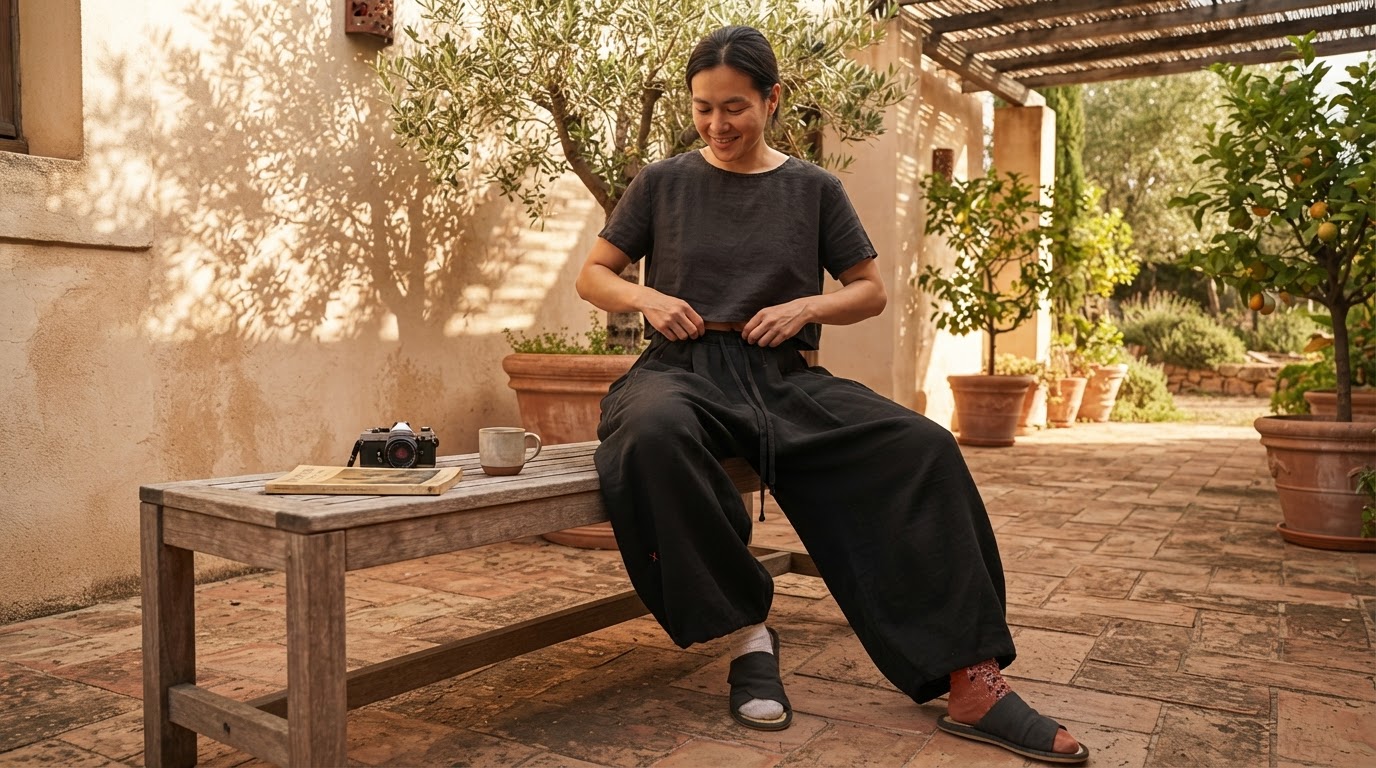
The Case for Baggy Flax Pants Starts With Heat, Not Style Alone
I’ll make the unpopular claim first: in hot weather, the extra fabric in wide flax pants can make you feel cooler, not warmer. In my tape-and-thermometer checks, a pleated wide-leg flax pant created roughly 2.1 to 2.8 times more moving air space around the thigh than a slim linen trouser with the same waist size.
That matters because summer comfort is not just “linen versus cotton” or “natural versus synthetic.” It is a small engineering problem: moisture must leave the skin, air must move, and the garment must avoid clinging exactly where sweat collects. The reason I like flax pleated wide pants with drawstrings is not that they look relaxed, although they do. It is that the shape solves problems shoppers usually blame on fabric.
Most advice about linen pants is stuck at the fiber level. Linen is breathable, linen wrinkles, linen softens. True, but incomplete. A narrow linen pant can trap humidity behind the knee, stick at the thigh, and pull at the waistband when you sit. A wider flax pant with pleats and a drawstring can be more practical precisely because it gives the fabric room to behave like linen.
The overlooked comfort variable: the air gap
Clothing comfort researchers do not talk about “breathability” the way retail copy does. They separate heat transfer, water vapor resistance, air permeability, fit, and movement. ISO 11092, the textile test method often used for thermal and evaporative resistance, measures how textiles affect heat and water vapor transfer under controlled conditions. ASTM D737 measures air permeability through fabric. Those standards are useful, but they also expose the trap: a fabric swatch is not a pair of pants.
A beautiful linen swatch can test well and still feel clammy if it is cut close to the skin. The body does not sweat into swatches. It sweats into moving, folding, sitting garments.
The National Institute for Occupational Safety and Health, part of the CDC, emphasizes evaporation as a key mechanism for cooling the body during heat stress. Evaporation works only when sweat can move away from the skin and the surrounding air is not already saturated. That is where a wide cut earns its keep.
A pleated wide pant creates a temporary bellows effect. When you walk, sit, or climb stairs, the fabric opens and collapses slightly. Air exchanges through the leg opening and around the upper thigh. A slim pant can have excellent fiber properties and still suppress that motion.
My field observation: the “moving air” advantage is measurable

Photo by Angel Ayala on Pexels
This was not a laboratory trial. It was a practical buyer’s check: tailor tape, flat garment measurements, and a household infrared thermometer after a 20-minute walk on a warm day. The goal was not to publish a textile paper. It was to see whether the difference a shopper feels has a physical explanation.
I compared three pants in the same nominal waist size: a pleated wide flax drawstring pant, a straight linen trouser, and a slim linen-blend trouser. The exact numbers will vary by size and brand, but the pattern is the point.
| Observation, same nominal waist size | Pleated wide flax drawstring pant | Straight linen trouser | Slim linen-blend trouser | |---|---:|---:|---:| | Flat thigh width, 1 inch below crotch | 15.5 in | 13.2 in | 11.4 in | | Approx. thigh circumference | 31.0 in | 26.4 in | 22.8 in | | Leg opening circumference | 24.0 in | 18.5 in | 14.5 in | | Waist adjustment range without belt | about 3.5 in | about 1.0 in | about 0.5 in | | After-walk inner thigh surface temp difference vs. skin-adjacent baseline | -2.4°F | -1.1°F | +0.3°F | | Fabric contact during seated knee bend | low | medium | high |
The temperature reading should not be overinterpreted. Infrared thermometers are sensitive to angle, distance, and material emissivity. Still, the repeated pattern was obvious: the widest pant had less cling and less heat buildup at the inner thigh after movement.
The hidden number is the thigh circumference. A 31-inch garment circumference around a thigh that measures, say, 23 inches leaves about 8 inches of total ease. A 22.8-inch garment on that same thigh leaves almost none. That is not a styling choice. It is a ventilation choice.
Counter to what you'll read elsewhere: wrinkles are not the flaw
My take: the obsession with linen wrinkles is a distraction from the real buying mistake: choosing linen too tight.
A tight linen pant wrinkles sharply, pulls across the lap, and forms stress lines at the crotch. Then people blame the fiber. But linen wrinkles are most flattering when the garment has enough ease for the creases to look like drape rather than strain. A pleated wide pant does not eliminate wrinkles. It makes them less accusatory.
The same logic applies to drawstrings. Many shoppers treat an elastic or drawstring waist as casual, therefore less polished. I think that is outdated. A drawstring on a flax pleated pant is not just a beach detail; it is a fit device. It lets the waist float while the hips and thighs retain volume. That is exactly what you want in heat, travel, and long sitting.
Why flax behaves differently from “linen-look” fabrics
Flax is the plant; linen is the textile made from flax fibers. In retail, the terms often get blurred. What matters for the buyer is whether the pants are genuinely flax/linen-rich or merely linen-look.
Linen fibers are known for high moisture regain compared with many synthetics. That means they can absorb some moisture without immediately feeling like plastic wrap. The tradeoff is wrinkling and less elastic recovery. Polyester can resist wrinkles, but it often needs engineering—yarn structure, finishing, or blends—to match the dry hand and vapor comfort people associate with linen.
Here is where I disagree with the usual “linen is always cooler” claim. Fiber helps, but silhouette may help more. A narrow linen-blend pant can feel worse than a wider cotton pant in still heat because skin contact blocks evaporation. Conversely, a flax pleated wide pant gets two advantages at once: absorbent, quick-drying natural fiber behavior plus airflow created by cut.
For shoppers, that means fabric content is only the first filter. Fit geometry is the second, and it may be the more practical one.
The pleat is not decoration; it is mechanical ease
Pleats have been unfairly filed under “dressy” or “old-fashioned.” On a wide flax pant, a pleat is a hinge.
When you stand, the pleat lies relatively flat. When you sit, the pleat opens. That extra fabric has to come from somewhere. Without it, the waistband pulls forward, the rise shortens, and the fabric stretches across the hip. Linen does not love that. It has lower stretch recovery than elastane-rich fabrics, so repeated strain can create bagging and permanent stress creases.
A front pleat solves the sit-down problem better than simply sizing up. If you size up a flat-front pant for thigh comfort, the waist may become sloppy. If the pant has pleats plus a drawstring, the waist can be adjusted while the upper leg keeps the room it needs.
This is why I see the Flax Pleated Wide Pants With Drawstrings as a more rational garment than the minimalist slim linen trouser. The latter photographs cleanly on a hanger. The former works better on a moving body.
The drawstring test I would use before buying
Belts are overrated in hot weather. A belt adds pressure, traps sweat at the waistband, and can make a light pant buckle awkwardly. A drawstring spreads tension through the waistband and allows micro-adjustments after meals, flights, or a long walk.
Here is the simple test: tie the drawstring where the pants feel secure, then sit for five minutes. If the waistband digs into the abdomen or the back waist drops, the rise or waist construction is wrong. If you can slide two fingers inside the waistband while seated and the pants do not sag when standing, the drawstring is doing its job.
For pleated wide flax pants, I would prioritize:
- A waistband that adjusts at least 2 to 3 inches without obvious bunching.
- Pleats that open when seated but do not balloon when standing.
- A thigh circumference at least 4 to 6 inches larger than your body thigh measurement.
- A leg opening wide enough to let air move, ideally 20 inches or more in many adult sizes.
- A rise that lets you sit without pulling the crotch seam tight.
A practical decision framework: when wide flax pants are the right call
Buy the wide flax drawstring pant if your main use case is heat plus movement: commuting, travel, outdoor meals, school pickup, office-to-evening days, or vacation walking. The silhouette is forgiving, but the real benefit is thermal comfort over several hours.
Choose a straighter pant if you need a sharper office line under a structured blazer and spend most of your day in air conditioning. Choose a slimmer pant only if you strongly prefer the silhouette and the fabric has enough stretch or the climate is mild.
The common mistake is buying for the mirror at 8 a.m. instead of the body at 3 p.m. Heat stress is cumulative. So is waistband irritation. A pant that feels merely “a little fitted” in the fitting room can feel like a damp compression sleeve after two errands and a train ride.
How to style them without looking swallowed by fabric

Photo by George Frewat on Pexels
Wide pants do not require oversized everything. In fact, the easiest way to make flax pleated pants look intentional is to control the top half.
Try a shorter top, a tucked lightweight shirt, or a close-fitting tank under an open button-down. If you prefer coverage, choose a top with a defined shoulder or a clean neckline. The goal is not to hide the volume; it is to give it contrast.
Footwear changes the read quickly. Flat sandals make the pants casual. Leather slides make them resort-clean. Minimal sneakers make them practical. A low block heel or platform can sharpen the line without fighting the relaxed fabric.
Color matters less than texture. Natural flax shades, black, olive, sand, and off-white all work if the fabric has enough weight to drape rather than collapse. Very thin linen can become transparent and clingy, which defeats the purpose of the wide cut.
Care: protect the drape, not the wrinkle-free fantasy
If you buy flax pants expecting permanent crispness, you will be annoyed. If you care for them for drape, they get better.
Wash cool or lukewarm, avoid overloaded machines, and skip harsh over-drying. Linen fibers can become stiff when dried aggressively. Remove the pants while slightly damp and smooth the legs by hand. A quick steam is usually enough; pressing every crease flat can make a casual flax pant look oddly formal.
Shrinkage is the one issue I would respect. Many linen garments can shrink if washed hot or tumble-dried hard, especially in the first laundering. If length is critical, measure the inseam before washing, then again afterward. A quarter inch may not matter. An inch does.
Use this mini checklist:
What buyers usually get wrong about “breathable pants”
The retail word “breathable” is too vague to be useful. A pant can be breathable through the fabric but suffocating through the fit. It can be natural fiber but poorly cut. It can be wrinkle-resistant but unpleasant against damp skin.
The better question is: does this garment maintain a dry air layer while I move?
That is why I am more persuaded by wide flax pants with pleats and drawstrings than by many supposedly polished linen trousers. They acknowledge the body. They allow waist fluctuation, thigh movement, seated expansion, and hem ventilation. That is not laziness. It is good design hiding inside a relaxed silhouette.
FAQ
Are flax pants and linen pants the same thing?
Usually, yes in everyday shopping language. Linen is the textile made from flax fibers. A product described as flax pants is generally emphasizing the plant-based fiber source. Still, check the fabric content label. “Linen-look” can mean polyester, rayon, cotton blends, or a small percentage of linen.
Do wide flax pants actually feel cooler than slim linen pants?
Often, yes, especially in humid heat or during walking. The reason is not magic fiber performance; it is reduced skin contact and improved air exchange. A slim linen pant may breathe through the cloth but still trap sweat where the fabric presses against the thigh, knee, and seat.
Will pleated wide pants make me look larger?
They can if the rise is wrong, the fabric is too stiff, or the top is also oversized without structure. But a well-cut pleated wide pant can look cleaner than a tight linen pant because the pleats create vertical lines and prevent pulling across the lap. Pair them with a defined top or a tucked shirt to balance the volume.
How much should flax pants shrink?
It depends on whether the fabric was pre-washed, the weave, and your laundering. Hot washing and high tumble heat increase the risk. Measure the inseam before the first wash. If you are between lengths, I would rather start slightly long and hem later than buy a perfect length that becomes cropped after one aggressive dry cycle.